
Stock of Wheat and Rice
GS paper 3: Major crops
Important for
Prelims exam: Climatic conditions, Statistics
Mains exam: Measures to curb Wheat and Rice Prices
Why in news?
Regulation in the export of wheat and atta has helped in controlling the prices, the Union Food and Public Distribution Ministry claimed and Secretary told that the increase in the prices came down from 15% to 5% after the regulation.
Key Points
- Centre decided to stop open market sales when wheat prices were going up.
- “Now, more stock is available for domestic consumption and public distribution system. As a result, the prices, compared to the prices in May, 2022, have come down about 7%.
- When asked whether the Centre would lift the ban on export, he said the primary concern of the government was food security of the country.
- Procurement of paddy in the kharif marketing season (KMS) 2022-23 had started and a quantity of around 277.37 lakh metric tonne (LMT) (185.93 LMT in terms of rice) had been procured up to November, 21, which was higher as compared to the procurement during the same period last year.
- 18.51 lakh farmers had benefited as 54,559.85 crores had been paid to farmers directly into their accounts.
- It is expected that procurement of paddy in KMS 2022-23 across the country will remain normal. The rainfall condition this year has been fairly good in the country and the production of paddy is expected to remain normal.
Wheat
- India is the second-largest producer of wheat in the world, with China being the top producer and Russia the third-largest.
- After five straight years of a bumper wheat output, India has had to revise downwards its estimated production.
- The revised crop size is reported as 102 mmt.
Climatic Conditions
- Temperature: Between 10-15°C (Sowing time) and 21-26°C (Ripening & Harvesting) with bright sunlight.
- Rainfall: Around 75-100 cm.
- Soil Type: Well-drained fertile loamy and clayey loamy (Ganga-Satluj plains and black soil region of the Deccan).
- Top Wheat Producing States: Uttar Pradesh > Punjab > Haryana>Madhya Pradesh > Rajasthan> Bihar>Gujarat
Wheat Statistics
- Export statistics: In the current financial year 2022-2023, the government estimates about 45 lakhs metric tonnes of wheat to have been contracted for exports.
- It has set a goal of exporting 10 million tons of the grain in 2022-23.
- Wheat production in India is expected to be lower than the earlier estimates.
- India exported 7 million tonnes(MT) of wheat in 2021-22 which is valued at $2.05 billion.
- Out of total shipment around 50% of wheat was exported to Bangladesh in the last fiscal year.
Wheat Producing States

Rice
- It is India’s largest agricultural crop (accounting for over 40% of the total food grain output)
- India is the world’s biggest exporter (around 40% of the world’s export)
- India is 2nd largest rice producer in the world after China.
- Top Rice Producing States: West Bengal > Punjab > Uttar Pradesh > Andhra Pradesh > Bihar.
- Aus, Aman and Boro: In states like Assam, West Bengal and Odisha, three crops of paddy are grown in a year.
Climatic Conditions
- Temperature: 22-32°C (high humidity)
- Rainfall: Around 150-300 cm.
- Soil Type: Deep clayey and loamy soil.
Rice Producing States

| Minimum support price (MSP)
The minimum support price (MSP) is an advisory price signal that is part of a larger set of agricultural policies in parts of India. This informal “support” price (as opposed to procurement or issue price) is recommended by the government and aims to safeguard the farmer to a minimum profit for the harvest while at the same time increasing food security in the country. The Indian government sets the price for about two dozen commodities twice a year.MSP is fixed on the recommendations of the Commission for Agricultural Costs and Prices (CACP),an apex advisory body for pricing policy under the Ministry of Agriculture.CACP in turn recommends the pricing according to a diverse range of factors including national requirements, available resources, farmer wages, cost of living and product competitiveness. |
Climate Change Performance Index (CCPI, 2023)
GS paper 3: Environmental pollution and degradation
Important for
Prelims exam: Indians Ranking, Indicator Used
Mains exam: Significance of Climate Change Performance Index
Why in news?
India has been ranked amongst top 5 countries in the world, and the best among the G20 countries, based on its Climate Change performance.
About CCPI
The Climate Change Performance Index (CCPI) is an instrument to enable transparency in national and international climate politics. The CCPI uses a standardized framework to compare the climate performance of 59 countries and the EU, which together account for 92% of global greenhouse gas emissions.
The climate protection performance is assessed in four categories:
- GHG (Green House Gas) Emissions,
- Renewable Energy,
- Energy Use and
- Climate Policy.
Climate Change Performance Index (CCPI, 2023) published by German Watch, New Climate Institute and Climate Action Network International based in Germany.
Overall Results CCPI 2023

Top 3 Position remain vacant
- No country was strong enough in all index categories to achieve an overall very high rating. Therefore, once again, the top three places remain empty.
- Denmark is again the top-ranked country, as in the previous year’s CCPI, but it does not perform well enough to achieve an overall very high rating.
G20 performance:
- With India (8th), the United Kingdom (11th), and Germany (16th), only three G20 countries are among the high performers in CCPI 2023. Twelve G20 countries receive an overall low or very low. The G20 has a particular responsibility in climate mitigation, as its members emit more than 75% of the world’s greenhouse gas emissions.
- Canada, Russia, South Korea, and Saudi Arabia are the G20’s worst-performing countries.
EU performance:
- Overall, the EU rises three spots from the previous year, to 19th, and just barely misses high classification. â Nine EU countries are among the high and medium performers, with Denmark (4th) and Sweden (5th) leading the overall CCPI ranking.
- Spain improves its performance in all four CCPI categories, vaulting it 11 spots to 23rd, though still performing at a medium level. France, in contrast, drops 11 ranks to 28th, mainly due to its poorer placement in the Climate Policy category compared with the previous year.
- Hungary (53rd) and Poland (54th) are the remaining EU countries receiving a very low rating.
Category Results – GHG Emissions

- After the sharp 5.2% drop in CO2 emissions in 2020, due to the COVID-19 pandemic, energy-related CO2 emissions in 2021 rebounded, increasing by 6% and reaching a record high.9 The CCPI results reflect this.
- The current IPCC report indicates global emissions must be halved by 2030 (compared with 2020 levels) to keep global warming within the 1.5°C reach.
- A strong rebound effect was expected, but now the countries need to intensify their efforts. Collectively, the countries the CCPI covered are responsible for more than 92% of all GHG emissions.
Category Results – Renewable Energy

- Renewable energy capacity continues to expand at a high pace amidst the economic recovery after the first phase of the COVID-19 pandemic.
- This comes despite supply chain challenges. In 2021, 257 GW of capacity was installed globally.
- Nonetheless, the energy system worldwide is still heavily dependent on fossil fuels.
- This is despite the fact wind and solar power generation are the cheapest sources of new electricity generation in most of the world.
Category Results – Energy Use

- The COVID-19 pandemic and subsequent slowdown of economic activity led to a 4% decrease in energy demand in 2020.
- However, a strong rebound was expected for 2021, as economic activity increased.
- The IEA estimated the global energy demand to rebound after its drop, increasing 4% in 2021 and returning to pre-pandemic levels.
Category Results – Climate Policy

- In light of the energy crisis, initiated by Russia’s aggressive war against Ukraine, climate policy fades into the background this year.
- Australia submitted a stronger National Determined Contribution (NDC) in 2022 and is, thus, the only G20 country to increase its ambition.
- Brazil and India did not increase their targets with their new NDCs.15.
- The UN United in Science Report states that the progress in NDC improvement is insufficient for keeping 1.5°C in reach.16 In the Climate Policy indicators in CCPI 2023, not only are national emissions targets assessed, but also sectoral targets and their specific implementation.
India’s Overview
- The country is among the high performing countries in the index. India earns a high rating in the GHG Emissions and Energy Use categories, with a medium for Climate Policy and Renewable Energy.
- The country is on track to meet its 2030 emissions targets (compatible with a well-below 2°C scenario). However, the renewable energy pathway is not on track for the 2030 target. Since the last CCPI, India has updated its Nationally Determined Contribution (NDC) and announced a net zero target for 2070.
- The country experts welcome the new targets and the political signals towards climate action. Despite India’s medium in the Renewable Energy category, the country has included renewables targets in its updated NDC.
- Yet the experts cite missing roadmaps and concrete action plans for achieving the targets. The experts stress the importance of a just and inclusive energy transition, as well as the need for decentralised renewable energy and capacities for rooftop photovoltaics.
- A carbon pricing mechanism, the need for more capacities at the subnational level, and concrete action plans for achieving the targets are key demands.
- India is among the nine countries responsible for 90% of global coal production. It also plans to increase its oil, gas, and oil production by over 5% by 2030. This is incompatible with the 1.5°C target.
Assam-Meghalaya border
GS paper 3: Security challenges and their management in border areas
Important for
Prelims exam: Disputed Areas, Tribes
Mains exam: Implications of Border Dispute
Why in news?
Both Meghalaya and Assam said they would seek a probe from a central agency into the Assam Police firing that killed six people along the states’ border.
Background
- Six people, including an Assam Forest Guard, were killed and several others injured during an alleged clash between the Assam Police and a mob, in an area bordering the West Karbi Anglong district of Assam and Mukroh village in Meghalaya’s West Jaintia Hills.
- Assam Police has claimed they opened fire in self-defence after a mob surrounded them when they were trying to intercept a truck allegedly smuggling timber.
- Five of those killed are from Meghalaya.
- The incident drew a sharp reaction from Meghalaya Chief Minister, who termed the Assam Police’s actions “inhuman” and said the state will set up a judicial commission and a Special Investigation Team to probe the shooting until a central agency takes over.
- Assam, in a statement announcing the setting up of the inquiry commission, said the incident took place in the West Karbi Anglong district, which is in Assam.
Disputed District Between Both states

What is the border dispute?
- During the British rule, undivided Assam included present-day Nagaland, Arunachal Pradesh, Meghalaya and Mizoram.
- Meghalaya was carved out in 1972, its boundaries demarcated as per the Assam Reorganisation (Meghalaya) Act of 1969, but has held a different interpretation of the border since.
- In 2011, the Meghalaya government had identified 12 areas of difference with Assam, spread over approximately 2,700 sq km.
- Some of these disputes stem from recommendations made by a 1951 committee headed by then Assam chief minister Gopinath Bordoloi.
- A 2008 research paper from the Manohar Parrikar Institute for Defence Studies and Analyses refers to the Bordoloi Committee’s recommendation that Blocks I and II of Jaintia Hills (Meghalaya) be transferred to the Mikir Hill (Karbi Anglong) district of Assam, besides some areas from Meghalaya’s Garo Hills to Goalpara district of Assam.
- The 1969 Act is based on these recommendations, which Meghalaya rejects, claiming these areas originally belong to the Khasi–Jaintia Hills.
- On the other hand, Assam says Meghalaya does not have the requisite documents to prove these areas historically belonged to Meghalaya.
Attempts to Resolve Issue
- In 1985, under then Assam chief minister Hiteswar Saikia and Meghalaya chief minister Captain W A Sangma, an official committee was constituted under the former Chief Justice of India Y V Chandrachud.
- From July 2021, Sangma and his Assam counterpart, held several round of talks to make some headway.
- Both state governments identified six out of 12 disputed areas for resolution in the first phase: three areas contested between West Khasi Hills district in Meghalaya and Kamrup in Assam, two between RiBhoi in Meghalaya and Kamrup-Metro, and one between East Jaintia Hills in Meghalaya and Cachar in Assam.
- Both sides submitted reports based on five mutually agreed principles: historical perspective, ethnicity of local population, contiguity with boundary, peoples’ will and administrative convenience.
- A final set of recommendations were made jointly: out of 36.79 sq km of disputed area taken up for settlement in the first phase, Assam would get full control of 18.46 sq km and Meghalaya of 18.33 sq km.
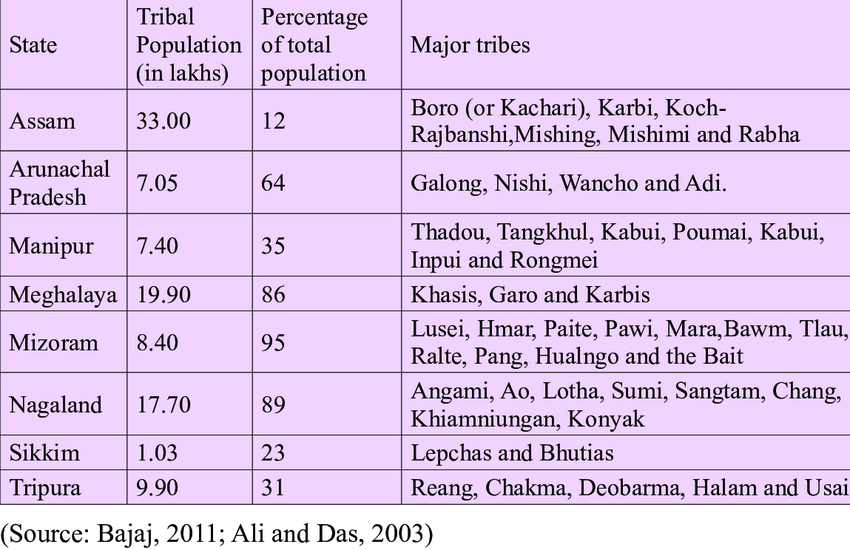
North East States Tribes
Cotton
GS paper 3: Major Crops
Important for
Prelims exam: Climatic Conditions, Statistics
Mains exam: Significance of Cotton
Why in news?
Cotton exports this year may fall short of the 40 lakh bales estimated recently by the Committee on Cotton Production and Consumption, traders.
Key Highlights
- Indian Cotton Association (ICAL), Bathinda, export enquiries are poor as Indian cotton is more expensive by 10 cents a pound compared with world cotton prices.
- Cotton arrivals in November usually surpass 1.5 lakh bales a day. At present, it is at 1.15 lakh to 1.3 lakh bales per day.
- President of Cotton Association of India (CAI) said farmers had sold cotton in the range of ₹10,000 to ₹15,000 per 100 kg in the last season and that the prices now are in the ₹9,000 per 100 kg range.
- “Prices are down 35% already.
- So farmers are not selling cotton.
- Indian Cotton Federation, said another major reason for tepid demand for cotton is the slowdown across the textile supply chain globally.
- Almost 50% of Indian cotton exports were to Bangladesh.
- China, Vietnam, Thailand, and Indonesia are the other major importers of Indian cotton.
- Bangladesh is said to be facing a crisis and there is no demand from that country.
Cotton
- Cotton is a soft, fluffy staple fiber that grows in a boll, or protective case, around the seeds of the cotton plants of the genus Gossypium in the mallow family Malvaceae.
- The fiber is almost pure cellulose, and can contain minor percentages of waxes, fats, pectins, and water.
- Under natural conditions, the cotton bolls will increase the dispersal of the seeds.
- The plant is a shrub native to tropical and subtropical regions around the world, including the Americas, Africa, Egypt and India.
- The greatest diversity of wild cotton species is found in Mexico, followed by Australia and Africa.
Conditions of Growth
- Cotton is the crop of tropical and sub-tropical areas and needs evenly high temperature changing between 21°C and 30°C.
- The growth of cotton is detained when the temperature falls less than 20°C.
- Ice is enemy number one of the cotton plant and it is grown in areas having at least 210 ice free days in a year.
- The modest necessity of water can be met by an average annual rainfall of 50- 100 cm.
- However, it is prosperously grown in areas of lesser rainfall with the help of irrigation. About one-third of the total area under cotton cultivation is irrigated.
Types of Cotton
Long staple cotton: It has the longest fibre whose length changes from 24 to 27 mm. The fibre is long, fine and shining. It is used for making fine and superior quality cloth.
Medium staple cotton: The length of its fibre is between 20 mm and 24 mm. About 44 per cent of the total cotton production in India is of medium staple.
Short staple cotton: This is inferior cotton with fibre less than 20 mm long. It is used for producing inferior cloth and earns less price. About 6 per cent of the total production is of short staple cotton.
| Cotton Corporation of India
CCI was established on 31st July 1970 under the administrative control of Ministry of Textiles, Government of India as a Public Sector Undertaking under the Companies Act 1956. In the initial period of setting up, as the only public sector undertaking in the field of marketing of cotton, CCI played a role of a canalizing agency for imports of cotton and purchase of raw cotton for giving necessary price support to enterprising cultivators and also for procuring raw cotton for textile mills. The role and function of CCI continued to enlarge with the changing cotton scenario in the country. Now, the major role of the CCI is to undertake price support operations, whenever the market prices of kapas fall below the minimum support prices (MSP) announced by Govt. of India, without any quantitative limit. Besides MSP operations, to fulfil the raw material requirement of the domestic textile industry particularly for lean season, CCI undertakes commercial purchase operations. |
Cotton Producing States
